
The Sphinx
Bob Dylan turns 85

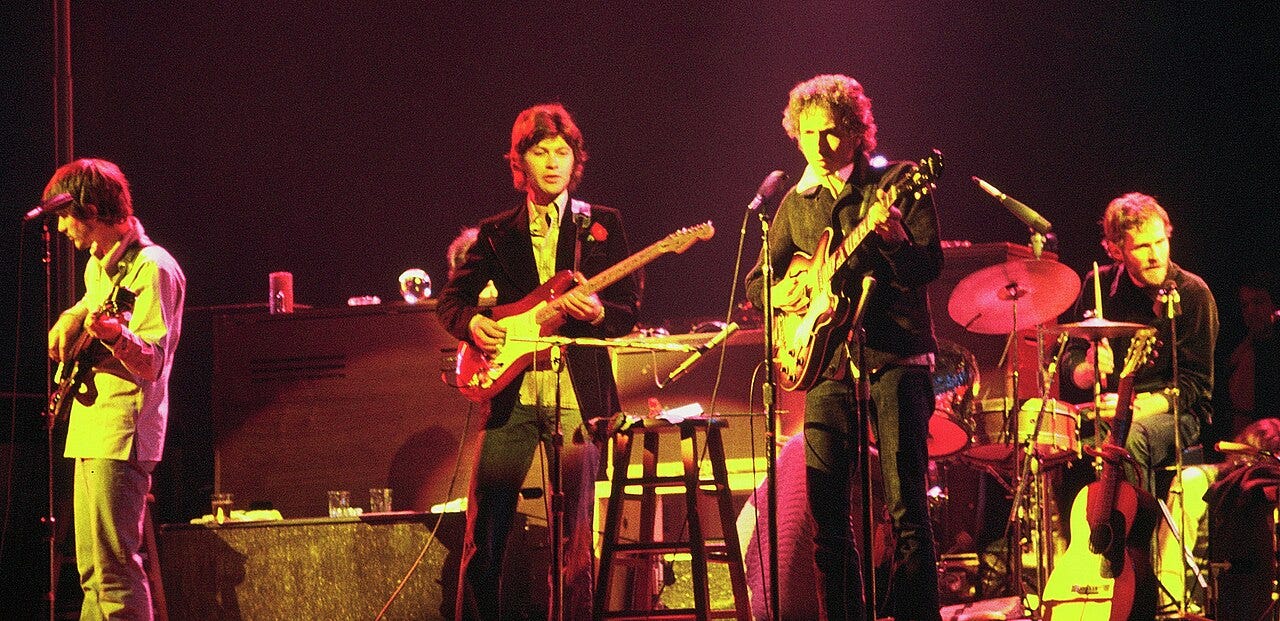
Dear reader: I have just released a book. It’s called Sirens, has received some fine reviews, and you can purchase it here or from your nearest, dearest bookstore.
For a long time, I found Bob Dylan very easy to hate. Not Dylan, exactly, but the exhausting idolatry he generated – a holiness upheld and defended, I thought, by unusually smug and pedantic followers.
And I mocked it. Mocked the legend, mocked the creepy defensiveness of his fans, mocked their tedious retelling of various chapters of The Book of Bob as if it were scripture and they victims of echolalia. Never again do I want to hear about the time our folkie Rimbaud went electric and his fans went mad.
But I can now see how, for decades, my own blithe rebellion conspired to estrange me from Bob, and how I threw the baby out with the bathwater. Now, and only now, have I come close to accepting Saint Dylan into my heart. I have wandered in the desert, parched, for many years.
*
For those with even a passing interesting in popular music, the Dylan origin myth is well known (and retold last year in the biopic A Complete Unknown). Born Robert Zimmerman in 1941, a suburban Jew alienated by the cultural aridity of Duluth, Minnesota, he fled to Greenwich Village in 1961 with a guitar, a new name and a colourfully invented past.
In New York City, Dylan sold himself as the spiritual offspring of Woody Guthrie and not the sheltered son of a furniture salesman. He told people that he’d been a carnie, possessed Native American blood, played piano on early Elvis records and had seen much of the country from the carriages of freight trains.
Creepy fabulist or chameleonic genius? It can be both. Long ago, before Dylan all but abandoned self-justification, he apparently said that life wasn’t about finding yourself but creating yourself. His mate Sam Shepard flatteringly refined this: “Dylan has invented himself. He’s made himself up from scratch. That is, from the things he had around him and inside him. Dylan is an invention of his own mind.”
In 2013, Joni Mitchell described the other side of that coin: “Musically, Dylan’s not very gifted – he’s borrowed his voice from old hillbillies,” she told CBS. “He’s got a lot of borrowed things. He’s not a great guitar player. He’s invented a character to deliver his songs … it’s a mask, of sorts.”
Relatively early in Dylan’s career, after the hysterical storm had settled after he went electric in ’65, he came to be revered as a musical conduit of American history – a kind of singing ouija board receiving vibrations from long-dead but still lonesome hobos. It was the music that mattered, not the variety of masks he wore to sing them, and, anyway, shapeshifting was authentic, right? It was the great American freedom of self-invention.
*
As cruel, snide and self-obsessed as Dylan could be, to watch footage of him from the 1960s is to encounter a powerful charisma, even if some of that might simply be the vibrations of black coffee and methamphetamine. But there was an aura, a charge to his self-enchantment. His famous singing voice helped too – intolerably nasal to some, it suggested to others an exhilarating conviction.
The cruelty and charisma of Dylan can be found in one of rock’s most famous documentaries: D.A. Pennebaker’s Don’t Look Back, a piece of cinema verité that takes as its subject Dylan’s 1965 tour of Britain. It was in Manchester that year that a fan yelled “Judas!” when Dylan returned to the stage with an electrified band and Dylan replied, “I don’t beleeeve you.”
While I find the Dylan in this documentary largely repellent – he humiliates Joan Baez on-camera, sadistically plays with a journalist, and speaks almost exclusively in a baffling, pretentiously oblique bohemian patter – there’s still something awe-inspiring in watching his indifference to the crowd’s hostility.
Dylan fanatics might see in the awkward encounters between their hero and the hacks sent to milk him for quotes something heroically contemptuous. But I only see the painful collision of journalistic stupidity with a brutally sneering and wilfully cryptic young man. Something’s going on, but you don’t know what it is, do you, Mr Jones?
Dylan was the Sixties’ ultimate hipster – always hinting at secret knowledge, deeper truths and revolutionary desires, but rarely caring to articulate them directly. But our genius was only a boy – “Judas” was 24 – and he would become more elusive as he became more exhausted with the consequences of his own mystique.
He continued to wear many skins and to speak in many voices, but if his reinventions and gnomic lyricism were meant as forms of escape, they only served to deepen his cult. To write about Dylan is to contemplate the astonishingly strange and enduring phenomenon of him, and to wonder if his evasions of public adoration only intensified its fascination.
*
In 1979, Bob Dylan morphed again in a way that proved more upsetting than when he adopted the Fender Stratocaster: he converted to Christianity, and for three years and three albums, exclusively devoted his music to a particularly aggressive style of evangelism. “Ya either got faith or ya got unbelief, and there ain’t no neutral ground,” he sang on “Precious Angel”.
Dylan’s conversion was severe, and, occuring in the wake of his marriage’s bitter dissolution and the worsening twitches of his booze-soaked exhaustion, critics felt obliged to submit his newfound faith to their patronising suspicions of a nervous collapse.
This wasn’t hard to do. The flavour of Dylan’s Christianity was decidedly fundamentalist. For stage banter in those years, gnomic gibberish was replaced with rants of hellfire, and his trilogy of “born again” records released between ’79 and ’81 – Slow Train Coming, Saved, and Shot of Love – were a chillier kind of gospel, and jarringly blunt and humourless.
“What we’re faced with here is really very ugly,” wrote Greil Marcus, one of Dylan’s most celebrated critics, in 1979 for New West magazine. “It’s not that Slow Train is drenched in religious imagery, or that a Jew has decided that the New Testament truly completes the Old. Throughout his career, Dylan has taken Biblical allegory as a second language; themes of spiritual exile and homecoming and personal and national salvation have been central to his work … [But] Dylan’s new songs have nothing of the sanctified quest in them: they’re arrogant, intolerant … and smug … It’s less God than Dylan’s own choice that’s celebrated.”
To many critics, Dylan’s evangelism didn’t seem to be a theatrical mask – another pose from our existential prankster – but the messy result of a crack-up. Ron Rosenbaum, a figure of the so-called “New Journalism” practised in some of America’s hipper magazines in the 1960s and ’70s, wrote for New York Magazine in 1979: “When I heard the born-again Bob album, I felt a sense of loss as a Jew. But on the other hand, it could have been worse – he could have become a Krishna, a Moonie, an EST-oid [a follower of Erhard Seminar Training], a heroin addict. I, for one, would counsel tolerance for this conversion, because throughout his career Dylan has had a habit of undergoing conversions and according to Theory Number 3: He hasn’t really changed at all … Hasn’t he always taken the stance of a biblical prophet using the word and fables of both Testaments to convey his outrage?”
Rosenbaum’s essay continues in this easy, half-joking manner, so it was a surprise to read in his uncooked, unforgivably repetitive book on Dylan last year, Things Have Changed, how vociferous he was in describing Dylan’s music and behaviour in those years as the ugliest and most damaging to his legacy, and the Californian Vineyard Christian Fellowship who courted him as a “cult” who exploited a then-vulnerable man.
Rosenbaum, it seemed, had held more tightly to Dylan’s conversion than the man himself.
*
Yes, Bob Dylan has played many roles – some chosen, some accidental, some projected by a hysterical public. These roles include gypsy, hipster and evangelical preacher. Zionist, folk custodian, the Voice of a Generation. Father, nomad and self-parodist. A medium for the ghosts of hillbillies past, a living jukebox of Americana. And, 10 years ago, Nobel laureate for literature.
That last distinction proved as divisive as his voice, though I remained perfectly indifferent. I was just glad that I’d heard of that year’s winner before. It is hard to take seriously a clan of Swedes meeting in locked rooms to acquit the endowment of the inventor of dynamite by anointing literary genius.
This you can’t take seriously. This I can’t beleeeve.
*
I experienced my own conversion recently to the cult of Bob. Just this year I’ve bought about 15 albums of his, including two from the official bootleg series. My submission had taken a long while, but I now think New Morning under-appreciated, and that its track “The Day of Locusts”, while appallingly produced, is a gem.
I agree that, from the late 1990s, he seemed to recover his own inspiration by communing once more with blues and folk standards. While rarely following his lyrics, much less understanding them, I can sometimes sense – feel – in certain albums the “thin, wild mercury sound” that Dylan spoke of as being the elusively perfect sound he strove for.
He described that to Ron Rosenbaum in a diner in 1978 while chain-smoking cigarettes. The interview appeared in Playboy. Dylan said: “The closest I ever got to the sound I hear in my mind was on individual bands in the Blonde on Blonde album,” he said. “It’s that thin, that wild mercury sound. It’s metallic and bright gold with whatever that conjures up.”
Dylan’s voice and distinctive phrasing, once abrasive, now often thrills me as kind of weird and mercurial liberation. His liberation, principally, but which can still occasionally free me from psychic constipation.
No, I’m not fanatical. Nor do I see Dylan as anything so pathetic as a puzzle to be solved. On his 85th birthday, I’m just grateful for the deep, fascinatingly uneven discography left by this jerk, genius, and old fantasist whose dreams unfortunately came true.
And that’ll do.